
Available 24/7
Blog
Divorce Lawyer vs. Family Law Attorney: Which One Do You Actually Need?
July 10, 2026
Choosing legal representation can feel confusing before your case even begins. Some firms describe themselves as divorce lawyers, while others use the term family law attorney. Are they different? Does one have more qualifications than the other? And which one is the better fit for your situation?
The answer is simpler than many people expect.
In Massachusetts, there isn’t a separate license for a “divorce lawyer” or a “family law attorney.” Both are licensed attorneys. The difference usually comes down to what they focus on in their practice and the types of cases they handle every day.
If you’re comparing attorneys, the title on a website should be one of the last things you consider. Experience with cases like yours, knowledge of Massachusetts family law, and a practical strategy will have a much bigger impact on your outcome.
This guide explains the difference, clears up a few common misconceptions, and helps you choose the attorney that’s right for your circumstances.
Key TakeawaysDivorce Lawyer vs. Family Law Attorney ✓ A divorce lawyer is typically a family law attorney who focuses primarily on divorce-related cases. ✓ Family law attorneys often handle a wider range of legal matters, including custody, child support, adoption, and post-divorce modifications. ✓ Massachusetts does not issue separate licenses for divorce lawyers and family law attorneys. ✓ The attorney’s experience with your specific legal issue matters far more than the title they use. ✓ Choosing a lawyer familiar with Massachusetts Family and Probate Court can make navigating the legal process much easier. |
Divorce Lawyer vs. Family Law Attorney at a Glance
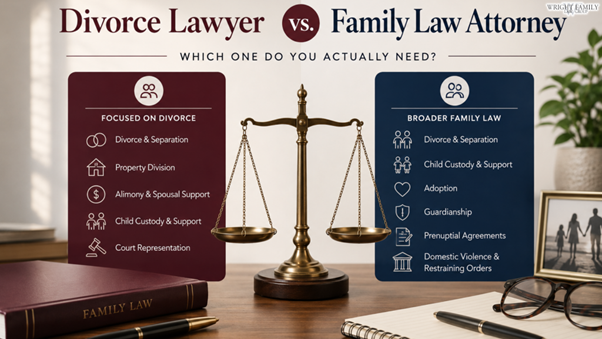
If you’re looking for the short answer, here it is: a divorce lawyer is usually a family law attorney who focuses primarily on divorce and the legal issues that come with it.
A family law attorney may also handle divorce, but their practice often extends to other family-related legal matters such as adoption, guardianship, paternity, child custody disputes, and post-divorce modifications.
The distinction isn’t about qualifications. It’s about the type of work an attorney spends most of their time doing.
| Divorce Lawyer | Family Law Attorney |
| Primarily focuses on divorce cases | Handles divorce along with a broader range of family law matters |
| Regularly advises on property division, alimony, and divorce strategy | May also assist with adoption, guardianship, paternity, and other family law issues |
| Frequently represents clients in contested and uncontested divorces | Can represent clients before, during, and long after a divorce is finalized |
| Often handles settlement negotiations and divorce litigation | May focus on custody modifications, child support, restraining orders, and other family court matters |
| Typically works extensively in Massachusetts Family and Probate Court | Also appears in Massachusetts Family and Probate Court across a variety of family law cases |
Choosing an attorney is about fit, not labels. Whether a lawyer calls themselves a divorce lawyer or a family law attorney, what matters most is their experience with the legal issues you’re facing and their ability to help you move forward with confidence.
What Does a Divorce Lawyer Do?
A divorce lawyer helps clients navigate the legal process of ending a marriage. While every case is different, their role goes far beyond filing paperwork or appearing in court. They provide legal advice, protect your interests during negotiations, and help you make informed decisions about your future.
Whether your divorce is straightforward or involves complex financial or parenting issues, a divorce lawyer can help you understand your rights and work toward an outcome that supports your long-term goals.
A divorce lawyer may assist with:
✓ Filing for divorce in Massachusetts
✓ Negotiating or drafting separation agreements
✓ Dividing marital property and debts
✓ Addressing alimony and spousal support
✓ Creating parenting plans and resolving child custody disputes
✓ Calculating and negotiating child support
✓ Representing you during mediation or settlement discussions
✓ Preparing your case for court when an agreement cannot be reached
✓ Enforcing or challenging existing divorce orders after the judgment
When should you hire a divorce lawyer?
While every situation is unique, legal guidance is especially valuable if:
- You and your spouse disagree on major issues such as property division, child custody, or support.
- One spouse owns a business, significant investments, or other high-value assets.
- You believe assets or income may not have been fully disclosed.
- Domestic violence, coercive control, or safety concerns are involved.
- Your spouse has already hired an attorney.
- You simply want to understand your legal options before making important decisions.
| A common misconception is that divorce lawyers only handle courtroom battles. In reality, many spend just as much time negotiating settlements, resolving disputes through mediation, and helping clients avoid unnecessary conflict whenever possible. |
What Does a Family Law Attorney Do?
Family law covers many of the legal issues that affect families throughout different stages of life. While divorce is one of the most common reasons people seek legal advice, it’s far from the only one.
A family law attorney may represent clients before a marriage begins, during a divorce, or years after a court order has been entered. The goal is to help individuals and families resolve legal matters that involve relationships, children, finances, and long-term planning.
Divorce and Separation
Many family law attorneys help clients with:
- Uncontested and contested divorces
- Legal separation
- Property division
- Alimony
- Divorce mediation
- Collaborative divorce
Children and Parenting
Family law also includes matters involving children, such as:
- Child custody
- Parenting plans
- Parenting time disputes
- Child support
- Paternity
- Custody and support modifications
- Relocation cases
Planning and Protection
Some family law services focus on preventing disputes or protecting families before problems arise, including:
- Prenuptial agreements
- Postnuptial agreements
- Guardianship
- Adoption
- Domestic violence and restraining orders
- Contempt and enforcement actions
Think of divorce law as one branch of a much larger tree. Family law is the broader practice area, and divorce is one of many legal matters that fall under it. That’s why you’ll often see attorneys describe themselves as family law attorneys, even if divorce makes up a significant part of their practice.
Why does this matter?
If your legal issue extends beyond the divorce itself, such as modifying a custody order, enforcing child support, or creating a prenuptial agreement before marriage, you’ll want an attorney whose experience matches those specific needs.
That’s why it’s worth asking not just “Do you handle divorce?” but also “How much of your practice is dedicated to cases like mine?”
Is There Really a Difference in Massachusetts?
The short answer is no.
Massachusetts does not issue separate licenses for divorce lawyers and family law attorneys. Both are licensed attorneys who have been admitted to practice law in the Commonwealth. What sets them apart is typically the focus of their practice, not their legal qualifications.
For example, one attorney may spend almost every day handling divorce cases involving property division, child custody, and alimony. Another may divide their time between divorce, adoption, guardianship, paternity, and other family law matters.
Both can represent clients in the Massachusetts Family and Probate Court. The key question is whether they have experience with the type of legal issue you’re facing.
Why experience matters more than the title
Family law isn’t one-size-fits-all. A straightforward, uncontested divorce requires a different approach than a high net worth divorce involving business interests or a post-divorce dispute over parenting time.
When comparing attorneys, consider questions such as:
- How much of their practice is dedicated to family law?
- Have they handled cases similar to yours?
- Are they experienced in negotiation, mediation, and litigation?
- Do they regularly appear in Massachusetts Family and Probate Court?
- Can they explain your options clearly and help you make informed decisions?
These answers will tell you far more than whether someone calls themselves a divorce lawyer or a family law attorney.
| A title tells you the type of law an attorney practices. Their experience tells you how prepared they are to handle your case. |
Which Attorney Is Right for Your Situation?
The right attorney depends less on the title they use and more on the legal challenges you’re facing. Here are a few common situations and the type of experience you should look for.
| Your Situation | What to Look For |
| You’re filing for divorce. | An attorney with extensive experience handling contested or uncontested divorces, depending on your circumstances. |
| You have children and need a parenting plan. | Someone with a strong background in child custody, parenting time, and developing practical parenting plans. |
| Your divorce involves a business, investments, or significant assets. | An attorney experienced in high net worth divorces, complex financial matters, and property division. |
| You need to change an existing court order. | A family law attorney who regularly handles modifications involving custody, child support, or alimony. |
| You and your spouse want to resolve things outside of court. | An attorney familiar with mediation and collaborative divorce who can help negotiate practical solutions. |
| You need immediate legal protection. | A family law attorney experienced in restraining orders, emergency hearings, and domestic violence matters. |
| You’re adopting a child or establishing guardianship. | An attorney whose practice includes adoption, guardianship, and other non-divorce family law matters. |
No two families are exactly alike, and neither are their legal needs. An attorney who is an excellent fit for a straightforward divorce may not be the right choice for a complex financial case or an adoption.
That’s why your first question shouldn’t be “What do you call yourself?” It should be “How often do you handle cases like mine?”
What Matters More Than the Job Title
By now, it’s clear that choosing between a divorce lawyer and a family law attorney isn’t really about the title. It’s about finding someone with the right experience for your circumstances.
Before making your decision, ask yourself:
- Does this attorney regularly handle cases like mine?
- Do they explain my options clearly?
- Do I feel confident in their approach?
- Are they familiar with Massachusetts family law and local court procedures?
An attorney’s title tells you what area they practice in. Their experience, communication, and strategy tell you whether they’re the right person to guide you through your case.
| Choose the attorney who fits your situation, not the title on their business card. |
Don’t Judge the Lawyer by the Label
Whether an attorney calls themselves a divorce lawyer or a family law attorney, your focus should be on one thing: Are they the right fit for your case?
A lawyer who regularly handles matters like yours will often be better equipped to anticipate challenges, explain your options, and guide you toward the outcome you’re hoping to achieve.
That’s a far better indicator of success than the title on their website.
Common Misconceptions
Myth: Every family law attorney handles divorce.
Reality: While many do, some attorneys focus primarily on adoption, guardianship, juvenile law, or other family-related matters.
Myth: Divorce lawyers only work on divorce cases.
Reality: Many also assist clients with child custody, child support, alimony, and post-divorce modifications.
Myth: The attorney’s title tells you how experienced they are.
Reality: Titles are often a matter of branding. Experience, practice focus, and familiarity with cases like yours are far better indicators of whether an attorney is the right fit.
Why Local Experience Matters
Family law is governed by state law, which means legal requirements and court procedures vary from one state to another.
Working with an attorney who regularly practices in the Massachusetts Family and Probate Court means you’ll have someone familiar with the state’s divorce laws, local court procedures, and the legal standards that apply to issues such as child custody, property division, child support, and alimony.
That local knowledge can provide valuable guidance whether you’re filing for divorce, negotiating a parenting plan, or returning to court to modify an existing order.
Final Thoughts
Whether an attorney calls themselves a divorce lawyer or a family law attorney, the title alone shouldn’t determine your decision.
What’s more important is finding someone who understands your circumstances, communicates clearly, and has experience handling cases similar to yours.
If you’re facing divorce or another family law matter in Massachusetts, Wright Family Law Group is here to help you understand your options and move forward with confidence.
Start with a free 15-minute discovery call to get your bearings, or book a comprehensive consultation to discuss your situation and build a strategy tailored to your goals.
Frequently Asked Questions
1. Is a divorce lawyer the same as a family law attorney?
A divorce lawyer is generally a family law attorney who focuses primarily on divorce-related matters. Family law attorneys may also handle custody, child support, adoption, guardianship, restraining orders, and other family law issues.
2. Which is better, a divorce lawyer or a family law attorney?
Neither is inherently better. The right choice depends on your legal issue. Look for an attorney whose experience closely matches your circumstances.
3. Can a family law attorney help with child custody if I’m not getting divorced?
Yes. Child custody, parenting plans, paternity, and child support are all areas of family law that may exist independently of divorce.
4. Do Massachusetts attorneys receive different licenses for family law and divorce law?
No. Massachusetts licenses attorneys to practice law generally. The distinction between a divorce lawyer and a family law attorney usually reflects the focus of their practice rather than a separate legal qualification.
5. When should I contact a family law attorney?
It’s often beneficial to seek legal advice as early as possible, whether you’re considering divorce, responding to a custody dispute, negotiating a prenuptial agreement, or dealing with another family law matter. Early guidance can help you understand your options before important decisions are made.

BEGIN YOUR JOURNEY TO RESOLUTION
Schedule Your Expert
Consultation Now

Attorney Advertising. This information is designed for general information only. The information presented should not be construed to be formal legal advice nor the formation of a lawyer/client relationship. Past results and testimonials are not a guarantee, warranty, or prediction of the outcome of your case, and should not be construed as such. Past results cannot guarantee future performance. Any result in a single case is not meant to create an expectation of similar results in future matters because each case involves many different factors, therefore, results will differ on a case-by-case basis. By providing contact information, users acknowledge and give explicit consent to be contacted via the methods of communication provided, including SMS. Message and data rates may apply. Message frequency may vary. Reply STOP to opt out.
Copyright 2026 All Rights Reserved | Accessibility Notice | Privacy Policy