
Available 24/7
Blog
2025 Massachusetts Child Support Guidelines
December 3, 2025

The 2025 Massachusetts Child Support Guidelines take effect on December 1, 2025, and apply to all child support orders entered or modified on or after that date.
These guidelines are based on the cost of raising children in Massachusetts and are reviewed every 4 years to ensure they remain fair, consistent, and aligned with families’ needs.
This guide provides a clear, accessible overview of the most important rules, factors, and processes involved in calculating child support in Massachusetts, using the official Guidelines, Worksheet, and Findings forms. These guidelines determine how a support order is calculated and enforced in Massachusetts.
For complete details, refer to the official documents:
- 2025 Child Support Guidelines (Mass.gov)
- Child Support Guidelines Worksheet (CJD 304)
- Findings and Determinations Form (CJD 305)
If you are a parent in Massachusetts and need to set up or review child support, these updates are important. This guide explains how the Massachusetts child support guidelines work and what parents should expect.
Why Massachusetts Updates Its Child Support Guidelines
Massachusetts must review its child support guidelines every four years. For the 2024–2025 cycle, the Trial Court assembled a Task Force and hired economic consultants fromThe Brattle Group to evaluate:
- What it actually costs to raise a child in Massachusetts
- Housing, childcare, healthcare, and educational trends
- A change in parenting arrangements and family structures
- Updates to the federal poverty guidelines
- Increases in the cost of living and inflation.
To summarize, these updates aim to ensure fairness across households and ensure child support reflects children’s needs and parents’ ability to pay.
What the Guidelines Presume
Under the Massachusetts law:
- The guidelines apply to all parents, married or unmarried.
- The guideline amount is presumptively correct unless a judge finds it unjust or not in the child’s best interest.
- The Massachusetts Child Support Guidelines Worksheet must be filed in every case.
- A Findings and Determinations (CJD 305) form must be filed if you are requesting (or agreeing to) a deviation, or if special circumstances apply.
Key 2025 Numbers at a Glance
Item | 2025 Amount / Rule |
Combined income cap | $450,000 per year ($8,654/week) |
Minimum order (payor earns ≤ $301/wk) | $15 per week |
Low-income ceiling ($302–$391/wk) | $33 per week maximum |
Childcare credit (per child) | Up to $430 per week |
College contribution cap | 50% of UMass-Amherst in-state cost (~$37,015 for 2025-26) |
Automatic hardship presumption | Order ≥ 40% of payor’s available income |
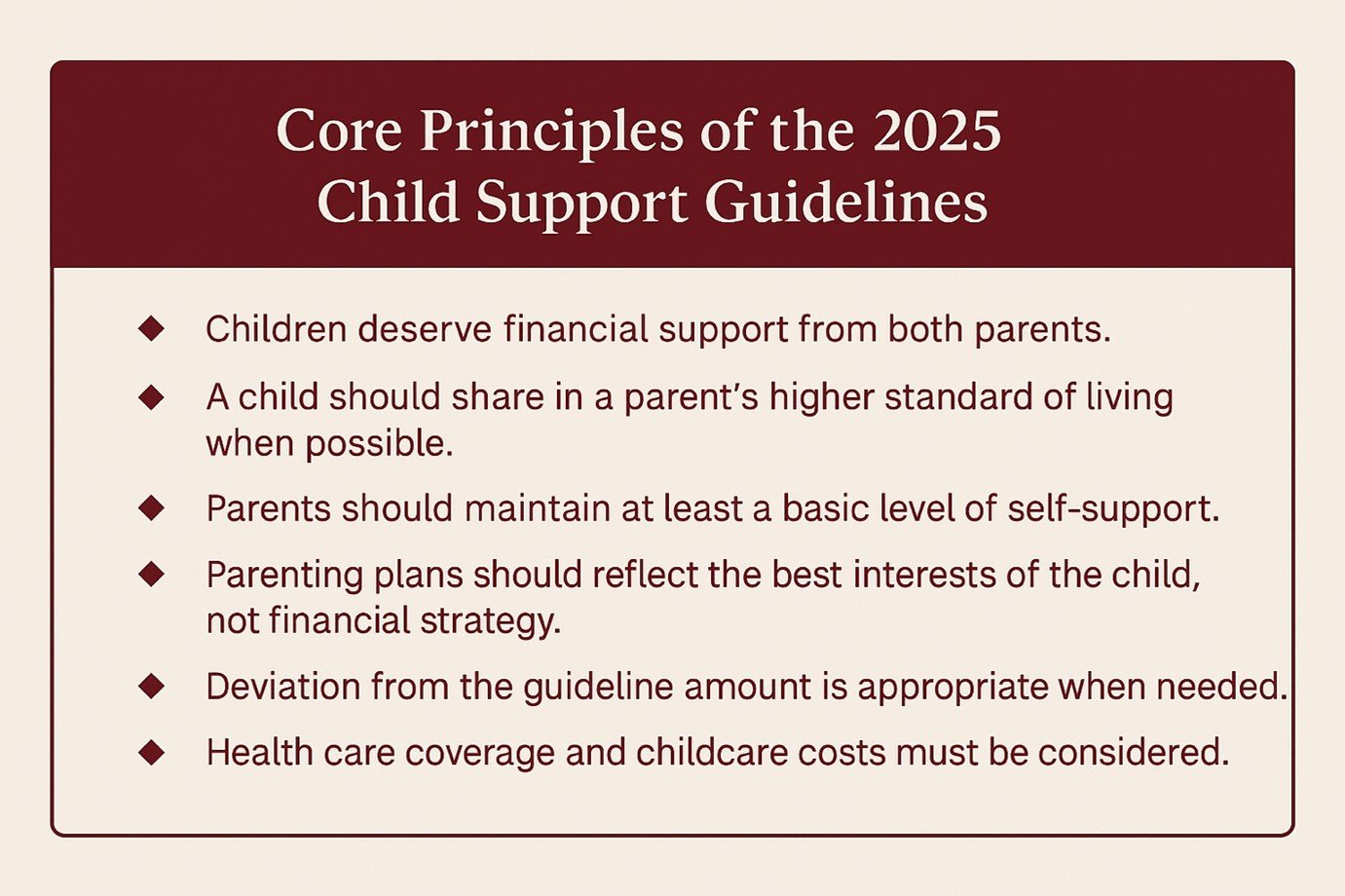
ALT Text: Infographic outlining child support core principles
What Counts as Income in Massachusetts?
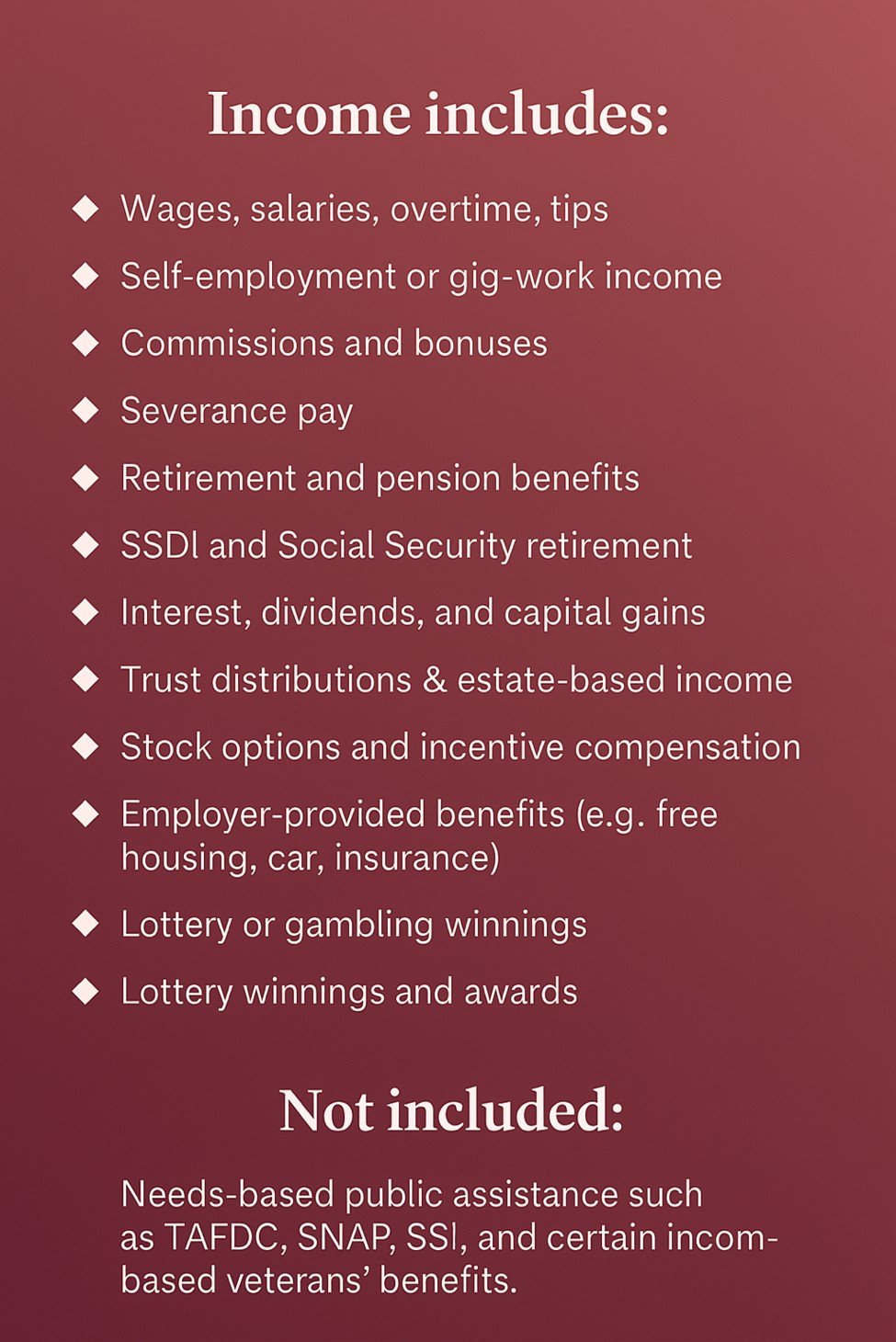
Massachusetts defines income very broadly. A parent’s income is the foundation of every child support calculation under the 2025 guidelines. For child support, income means gross income from almost any source, including income not reported to the IRS.
Overtime & second jobs
A judge may include some, all, or none of this income based on:
- How long you’ve worked overtime
- Whether it will continue
- Whether it affects parenting time
- Financial needs
- Whether the extra work is mandatory
If overtime or a second job started after the order was entered, the court presumes it should not be considered for a future order.
Imputing or attributing income
When a parent’s lifestyle differs from their claimed income, the court may grant them a higher income when:
- Their lifestyle doesn’t match the reported income
- They receive free housing or in-kind benefits.
- They are capable of earning more but are voluntarily unemployed or underemployed.
Important: Massachusetts cannot treat incarceration as voluntary unemployment.
Key Factors Massachusetts Courts Consider
In Massachusetts, courts consider income and several additional factors when determining child support. Key considerations include:
Alimony and child support
Child support is meant for children, while alimony is for spouses. If both are involved, courts review different support options (per Cavanagh v. Cavanagh) and pick the fairest outcome.
Tax dependency
Judges can decide which parent gets to claim the child on their taxes.
Minimum and Maximum Support Levels
If the person paying support earns $301 a week or less, they will not pay more than $15 a week.
If they earn between $302 and $391 a week, they will not pay more than $33 a week.
The guidelines apply when parents have a combined income of up to $450,000 per year. If the income is higher, the court determines the appropriate support amount.
Updated Income Percentages in 2025
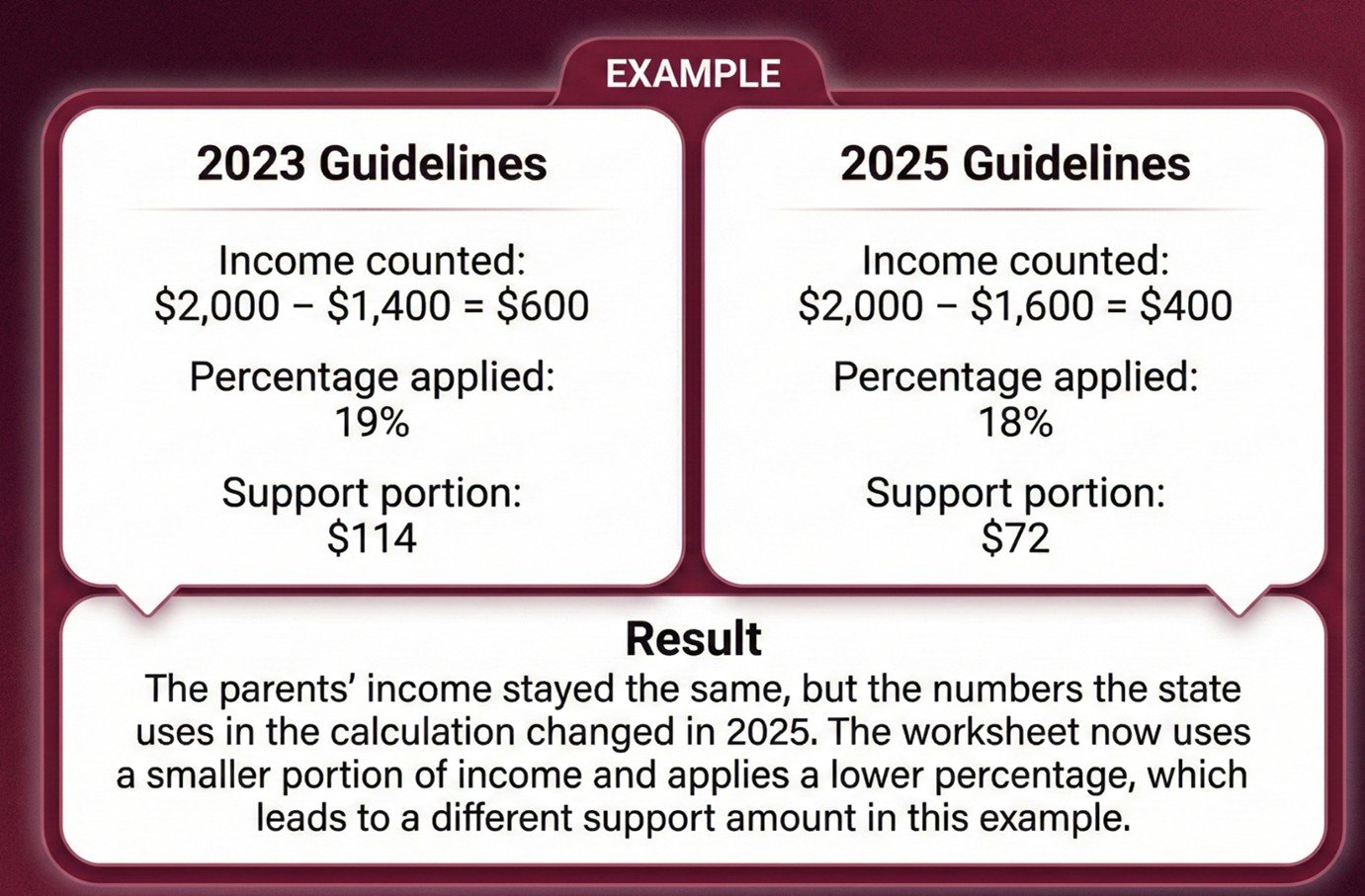
The child support worksheet uses income brackets to determine how much a parent pays in child support. Each bracket has a set percentage applied to a portion of the parent’s income. This is how the state ensures support amounts remain predictable and consistent.
For 2025, these brackets and percentages were updated. This means the worksheet now uses slightly different numbers than it did in 2023. As a result, a parent can end up with a different support amount even if their income has not changed.
Some families may see a higher amount. Some may see a lower amount. It depends on where their income falls in the new chart.
This update is important because a support order based on the 2023 guidelines may now be out of line with the 2025 rules, which can be a valid basis for a modification.
Parenting time
Parenting time plays a key role in deciding which parent is the recipient and how the support order is calculated. The child support worksheet adjusts payment obligations according to the following arrangements:
- Primary residence
- Shared parenting, in which both parents have approximately equal time and responsibility
- Split parenting, where each parent serves as the primary caregiver for different children
Potential deviations from standard calculations include the following scenarios:
- When a parent spends significantly less than one-third of the total parenting time, support payments may be increased.
- If parenting time falls between one-third and half, an adjustment could be considered.
- In cases with more than two legal parents, the court reviews each parent’s income and time spent with the children.
The worksheet itself lets you choose from two basic parenting categories:
- A primary residence schedule (one parent has most of the time)
- A shared 50/50 schedule
But in real life, many families fall somewhere in the middle.
What the 2025 guidelines change:
Judges now have clearer permission to adjust child support when parenting time is:
- More than one-third but less than half (in-between schedules)
- Substantially less than one-third
- Involving more than two legal parents
Why this matters:
Parents don’t need to force their parenting plan into one of the worksheet’s “boxes.” The court can adjust support to reflect the actual time spent with the children.
Example:
If a parent has the children about 40% of the time, not a full 50/50 but more than a typical schedule, the court can adjust the support amount to match the actual parenting arrangement.
Pro tip: Parents facing conflict or juggling complicated schedules can turn to a parenting coordinator for guidance, structure, and ongoing support.
Childcare costs
The 2025 guidelines now give more detail about when a camp or activity counts as “childcare” (which affects the child support amount) versus when it’s simply an extracurricular activity (which does not).
A camp may count as childcare when:
- It provides supervision so a parent can work, attend school, or do job training.
- It happens during working hours.
- The child is young enough to require supervision.
- The program functions like a caregiver during the day.
A camp may NOT count as childcare when:
- It’s primarily recreational or enrichment-based.
- Attendance isn’t linked to a parent’s ability to work.
- The child is old enough to be safely home alone during the same hours.
Why this matters:
This distinction can change the final child support number for many families.
Support for children ages 18–23
Massachusetts is one of the few states allowing child support up to age 23.
Courts consider:
- Why the child still lives with the parent
- School enrollment
- Resources of each parent
- Contribution to college costs
- The child’s living situation
- High school students 18+ are treated as under 18 for support calculations.
- For children aged 18–23 who are not in high school, support is reduced using Table C on the worksheet.
College contributions
Courts can require parents to help pay for their child’s undergraduate education.
Key rules:
- No parent can be required to pay more than half the cost of UMass Amherst unless the judge explains the reasons in writing.
- The term “cost” covers tuition, required fees, housing, meal plans, and books.
- Judges look at what each parent can afford, any financial aid, the child’s needs, and each parent’s financial situation.
Health, dental, and vision Insurance
Parents may deduct reasonable premiums actually paid. Coverage must be:
- Affordable (no more than 5% of gross income)
- Accessible (within 15 miles of the child’s home)
- In the child’s best interest
If a plan covers people not listed in the order, the deduction may be reduced.
Out-of-pocket medical expenses
Older versions of the guidelines defaulted to splitting medical expenses 50/50 after the recipient paid the first $250.
The 2025 guidelines change that.Courts can now divide uninsured medical expenses based on each parent’s income share, rather than automatically 50/50.
Important:
The court considers each parent’s income before child support is paid or received, so this division reflects each parent’s actual financial ability—not the result of the child support order.
Example:
If Parent A earns 70% of the combined income and Parent B earns 30%, the court may order Parent A to cover 70% of the medical expenses.
Families with more than two legal parents
Beginning January 1, 2025, the Massachusetts Parentage Act (MPA) allows a child to legally have more than two parents.
The 2025 Child Support Guidelines reflect this by stating:
Courts must consider the financial circumstances and parenting time of all legal parents when deciding support.
Why this matters:
Some families may share parenting among three adults — for example:
- Two biological parents and one de facto parent
- A same-sex couple and a biological father
- A blended family where all parents share legal status
There is no worksheet that calculates support for three parents yet, so judges have broad discretion to determine a fair arrangement.
Other children and existing obligations
Courts may deduct:
- Existing support orders being paid
- Reasonable voluntary support payments
- Hypothetical support for another child in the home (if evidence is provided)
Multiple Children
The worksheet adjusts child support based on the number of children, using updated Table B factors for 2025.
Other Child-Related Expenses
Judges may order contributions toward:
- Extracurricular activities
- Private school
- Camps that are not childcare
Discretion depends on affordability and the child’s best interest.
Modifying a Massachusetts Child Support Order
You may request a modification when:
- The guideline amount today is different from your current order.
- Health insurance becomes unavailable, unaffordable, or newly available.
- There is any material and substantial change (job change, parenting time change, disability, etc.)
If the old order included a deviation, courts examine whether:
- The reasons still exist.
- Continuing deviation is in the child’s best interest.
- The guideline amount would be unjust.
If your old order does not match the amount produced by the Massachusetts child support worksheet, you may qualify for a modification.
Deviation (Higher or Lower Orders)
Courts can deviate upward or downward, including issuing a $0 order, when:
- Parents agree (and it’s fair to the child).
- A child or parent has extraordinary needs.
- Childcare, medical, or insurance costs are unusually high.
- Parenting time is substantially less or more than typical.
- The child has more than two legal parents.
- The payor is incarcerated with no ability to pay.
- Applying the guidelines leaves a parent unable to self-support.
- Applying the guidelines would create a major disparity between households.
- Reunification under DCF (G.L. 119) would be harmed.
- The guideline amount would otherwise be “unjust, inappropriate, or not in the child’s best interest.”
40% Rule
If child support exceeds 40% of the payor’s available income, courts presume a hardship exists and are more likely to deviate.
Understanding the Massachusetts Child Support Worksheet
The 2025 Child Support Guidelines Worksheet calculates:
- Available income
- Parenting time category
- Adjustments for multiple children
- Reductions for children ages 18–23
- Childcare and medical credits
- Minimum or maximum order bands
- Whether the 40% hardship threshold is triggered
This worksheet is the main tool for figuring out child support under the 2025 guidelines. Every case uses the Massachusetts child support worksheet to determine the support amount.
Many parents find the worksheet confusing, especially when it comes to shared parenting, stock options, self-employment, or college costs. Getting legal advice can be very helpful in these situations.
When to Get Legal Guidance
At first glance, Massachusetts child support may seem simple, but many parents discover there is more to it once the details are applied. A family law attorney can help you understand how the guidelines apply to your situation and whether a deviation may be appropriate.
You should consult a family law attorney if you:
- Believe the guideline amount is unfair.
- Want to request a deviation.
- Share parenting time close to 50/50.
- Have a child with special needs.
- Have complex income (self-employment, bonuses, stock, rental income).
- Have children 18–23 or facing college decisions.
- Need to modify an old order.
- Have more than two legal parents.
- Face a situation where child support may exceed 40% of available income.
Wright Family Law Group Can Help
If you have questions about child support, custody, parenting time, or whether your present order fulfills your family’s requirements, you do not have to face them alone. Wright Family Law Group offers straightforward guidance and practical solutions while always prioritizing your child’s well-being.
Wright Family Law Group has offices in Danvers and Tewksbury, serving clients across Massachusetts, including Middlesex, Essex, Suffolk, Plymouth, Norfolk, Bristol, Worcester, and Barnstable counties. Schedule a free 15-minute discovery call today to get individualized advice and start ensuring your family’s future.
Massachusetts Child Support Guidelines FAQ
- What is the minimum child support payment in Massachusetts?
The minimum order is $15 per week for payors earning $301 or less, and up to $33 for income between $302 and $391. - What is the maximum income the Massachusetts guidelines use?
The 2025 guidelines apply up to $450,000 in combined parental income; anything above that is discretionary.
- How much child support would I pay if I earn $2,000 a week in Massachusetts?
It depends on parenting time and deductions. The worksheet applies the updated 2025 income brackets and percentages to calculate the exact amount.
- Who pays child support in a 50/50 parenting schedule in Massachusetts?
Even with equal parenting time, support may be ordered based on each parent’s income and ability to meet the child’s needs.
- What is the lowest child support payment allowed?
$0 is possible when a parent cannot pay, and a deviation is appropriate under the guidelines.
- How is child support calculated in Massachusetts?
Child support in Massachusetts is calculated using the official Child Support Guidelines Worksheet, which looks at each parent’s income, parenting time, childcare costs, and other required expenses to determine the support amount.

BEGIN YOUR JOURNEY TO RESOLUTION
Schedule Your Expert
Consultation Now

Attorney Advertising. This information is designed for general information only. The information presented should not be construed to be formal legal advice nor the formation of a lawyer/client relationship. Past results and testimonials are not a guarantee, warranty, or prediction of the outcome of your case, and should not be construed as such. Past results cannot guarantee future performance. Any result in a single case is not meant to create an expectation of similar results in future matters because each case involves many different factors, therefore, results will differ on a case-by-case basis. By providing contact information, users acknowledge and give explicit consent to be contacted via the methods of communication provided, including SMS. Message and data rates may apply. Message frequency may vary. Reply STOP to opt out.
Copyright 2026 All Rights Reserved | Accessibility Notice | Privacy Policy